
Learn › Equipment
Choosing your first freediving mask: fit, and the part that actually stops Asian faces
You do not need to try on twenty masks. One suction test tells you whether it fits. But the thing that actually stops most Asian divers is not the fit — it is the nose pocket, because almost every low-volume mask on the market is moulded for European faces.
Safety first. A mask is the one piece of gear that presses directly against your face, and the wrong one does not just feel bad, it can injure you. Later on this covers mask squeeze, which is not rare, and why swimming goggles must never be used for diving down. Any in-water practice needs someone watching you.
Plenty of people buy their first mask by trying on one after another in the shop, and walk out still unsure which one suits them.
There is a simple test that settles it. No water needed — you can do it standing in the shop.
The suction test: thirty seconds to know
Here is how it goes:
- Flip the strap forward, over the front. Nothing behind the mask should be in the way.
- Push the hair off your forehead. Clear it completely — a single hair across the skirt is enough to break the seal and give you a false result.
- Place the mask gently on your face, then inhale lightly through your nose.
- Let go. If the mask stays on your face without falling, it fits.
Once it holds, do one more thing: shake your head around. Sticking while you stand still does not prove it will stick once you are moving in the water.
Only then put the strap on, adjust the tension, and check two things — whether the skirt is sealing evenly all the way round, and whether it feels too tight or too loose overall.
The strap is there to hold the mask in position, not to clamp it down. If a mask only stops leaking when you crank the strap tight, it does not fit your face. And over-tightening makes pressure marks and bruising more likely, not less.
To be honest though: masks are made well these days. The skirts are generously sized and cover very nearly every face shape. So run the test, but do not agonise over it — what usually stops people is not the fit, it is the thing in the next section.
What actually happens inside the mask as you descend
This is the part almost nobody explains, and it decides everything that follows.
First: the air does not escape. It is only compressed.
The mask is sealed and the air inside has nowhere to go. As pressure rises on descent, those air molecules are squeezed into a smaller space — the amount does not change, only the room it occupies.
Second: but the mask is rigid, so the volume cannot shrink.
This is the crux. The gas wants to occupy less space, but the frame will not deform. So that shrinkage has to come from somewhere else — your face.
Your eyelids, the soft tissue around your eyes, and the eyes themselves get pushed into the mask.
Third: the amount is far larger than you would guess.
At 10 metres the pressure is twice that at the surface, so the gas has to halve in volume to balance. For a 100 mL mask, that means 50 mL of your face has to bulge inward — about three tablespoons.
Your face cannot give up three tablespoons. So the pressure never balances, the deficit stays, and it becomes a continuous force pulling on your face. That difference can approach a full atmosphere.
So the answer to "why equalise the mask" is: because if you do not add air, your face fills the gap. And your face cannot fill it.
Why it feels like the mask is sucking air out of your nose
Many people describe it as the mask drawing air out of the nose. That description is accurate — it really is drawing.
Here is why: your airway is at ambient pressure. Water compresses your chest, so the gas in your lungs equilibrates with the surrounding pressure. But the pressure inside the mask is below ambient — that is the deficit above.
Ambient on one side, below-ambient on the other. As long as the passage between them is open, gas flows from your airway into the mask on its own.
That is why some divers find they never consciously blow: keeping the nasal passage relaxed and open is enough. Exhaling gently just makes it more deliberate.
Does smaller volume really save air? You can calculate it
Yes, and the arithmetic is straightforward.
To hold the mask at ambient pressure, the air it needs rises in proportion to depth. Expressed in surface air, the rule is simple:
At an ambient pressure of P atmospheres, the mask needs to swallow an extra (P−1) times its own volume in surface air.
Which gives:
| Depth | Pressure | 100 mL low-volume mask | 250 mL standard mask | Difference |
|---|---|---|---|---|
| 10 m | 2 atm | 0.1 L | 0.25 L | 0.15 L |
| 20 m | 3 atm | 0.2 L | 0.5 L | 0.3 L |
| 30 m | 4 atm | 0.3 L | 0.75 L | 0.45 L |
(All litres here are surface-equivalent air.)
Laid out step by step, at 30 metres and 4 atmospheres:
- To sit at 4 atm, the mask needs 4 × its own volume in air (measured as surface air)
- It only brought 1 × its volume down from the surface
- So it needs 3 × its volume added
A 100 mL mask: 3 × 0.1 = 0.3 litres. A 250 mL mask: 3 × 0.25 = 0.75 litres.
A full breath is around 6 litres for many people, so 0.3 ÷ 6 ≈ 5% and 0.75 ÷ 6 ≈ 12%.
Why are the percentages different at the same depth? Because what changed is not the depth, it is the mask. Same depth means the same "needs 3× its volume" multiplier; but a 250 mL mask is already 2.5 times bigger than a 100 mL one, so the amount added is 2.5 times bigger too. Same multiplier, different base.
One more thing worth noticing: what the mask costs is a fixed absolute amount, regardless of how big your lungs are. So for the same mask, a diver with smaller lungs pays a higher percentage. A low-volume mask is actually a better deal for a smaller person than for a large one.
The gap is about 7% — not decisive, but not nothing either. What makes it matter is that it is taken from you at your deepest point, when air is scarcest, and it is the same air you need for equalising your ears.
There is a second reason, and this one is about safety: the bigger the volume, the more of your face has to give way. At the same 10 metres, a 100 mL mask demands 50 mL and a 250 mL mask demands 125 mL. So if you do forget to add air, a large mask injures you considerably more.
(For what it is worth, deep competitors use a noseclip with fluid goggles precisely to reduce this cost to zero.)
The part that actually stops Asian faces: the nose pocket
With fit settled, here is what matters most.
Asian nose bridges are generally flatter. But almost every low-volume mask on the market is still built for the European and American market, on European face moulds. So this happens: the skirt seals beautifully on your face, but the nose pocket is too deep and too stiff for you, and your fingers cannot reach your own nose inside it.
That is not something wrong with you. It is the mould. It happens often.
Why does the nose pocket matter so much? Because underwater you need it for two separate jobs:
| What you do | What it is for |
|---|---|
| Pinch your nose | Equalising your ears |
| Exhale a little through your nose | Equalising the mask itself |
If you cannot do both, you are not going down. No pinch means no ear equalisation. No exhale means your face gets sucked into the mask.
So make this part of every fitting:
- Pinch your nose, then pretend to exhale through it. Check that the air does not escape badly while you are pinching. If it escapes, you were not really pinching.
- If you already know how to equalise, just do it wearing the mask. That is the most direct test there is.
If you cannot reach, change how you pinch
If you genuinely love a mask but your fingers cannot reach your nose inside it, do not give up on it yet.
Most people pinch by squeezing inward from both sides. In a deep nose pocket, that often does not reach.
Try this instead: press inward toward your face first, then pinch toward the middle.
Your fingers go in toward the face, make contact with the nose, and only then squeeze. Changing from "squeeze toward the middle" to "press in toward the face" is enough to make many masks workable.
It is a perfectly efficient way to pinch. So if you love a mask and all it needs is a different pinch technique for you to equalise — that is a good outcome. There is no need to give up a mask that otherwise fits your face well.
A mask is a consumable — you do not have to buy an expensive one every time
When people ask which model I recommend, my answer is: any low-volume mask, broadly speaking.
What I do not recommend is buying an expensive mask every single time, because a mask is a consumable.
Two things wear out:
First, the lens scratches. Especially on curved masks, where the lens is usually resin. Resin is much softer than glass and scratches fairly easily.
Second, the skirt has a shelf life. Silicone skirts stiffen over time even if you never use them. Once the silicone hardens, the seal gets worse and the mask starts letting water in. It ages on the shelf too.
Some masks do have replaceable lenses now. But unless it is a mask you genuinely love, or a classic you want to keep, I would not spend a thousand dollars on one every time. I usually dive with masks whose lenses cost a couple of hundred.
Unbranded masks are fine — but test them before you get in the water
There are unbranded masks on marketplaces like Shopee, and they are perfectly buyable.
For those, though, I would test it before you get in the water — take it to the bathtub and check whether it actually keeps water out. Finding a leak in your bathtub and finding a leak out at sea are two very different experiences.
Another thing I often suggest: take more than one mask to the pool or to open water. If one turns out uncomfortable or keeps flooding, you have another to switch to, instead of writing off the whole session.
Straps: what people with long hair should know
You can also buy fabric straps for masks online.
A fabric strap is not just about looking good the way mermaid performers do. For anyone with long hair, a fabric strap is much less likely to catch and pull it. Silicone straps grab hair; fabric ones mostly do not.
Two things to watch for:
- Do not get one that is too thin. A thin strap does not hold firmly enough and the mask will not stay put.
- Fabric straps lose their elasticity over time too, so they are consumables as well and will eventually need replacing.
And if you would rather not switch to a fabric strap? With long hair, the silicone strap that came with the mask slips very easily. In that case I would suggest wearing a hood first, then the silicone strap over it. The hood gives the strap a surface to grip, and it stops sliding off.
A new mask has to be de-filmed, or nothing will stop it fogging
Plenty of people do not know this, and it is the number-one reason new masks fog.
Masks ship with a silicone release film on the inside of the lens, put there to protect it during manufacturing and transport. If that film is not completely removed, no amount of defogging will work — spit, commercial defog, anything, it will fog anyway.
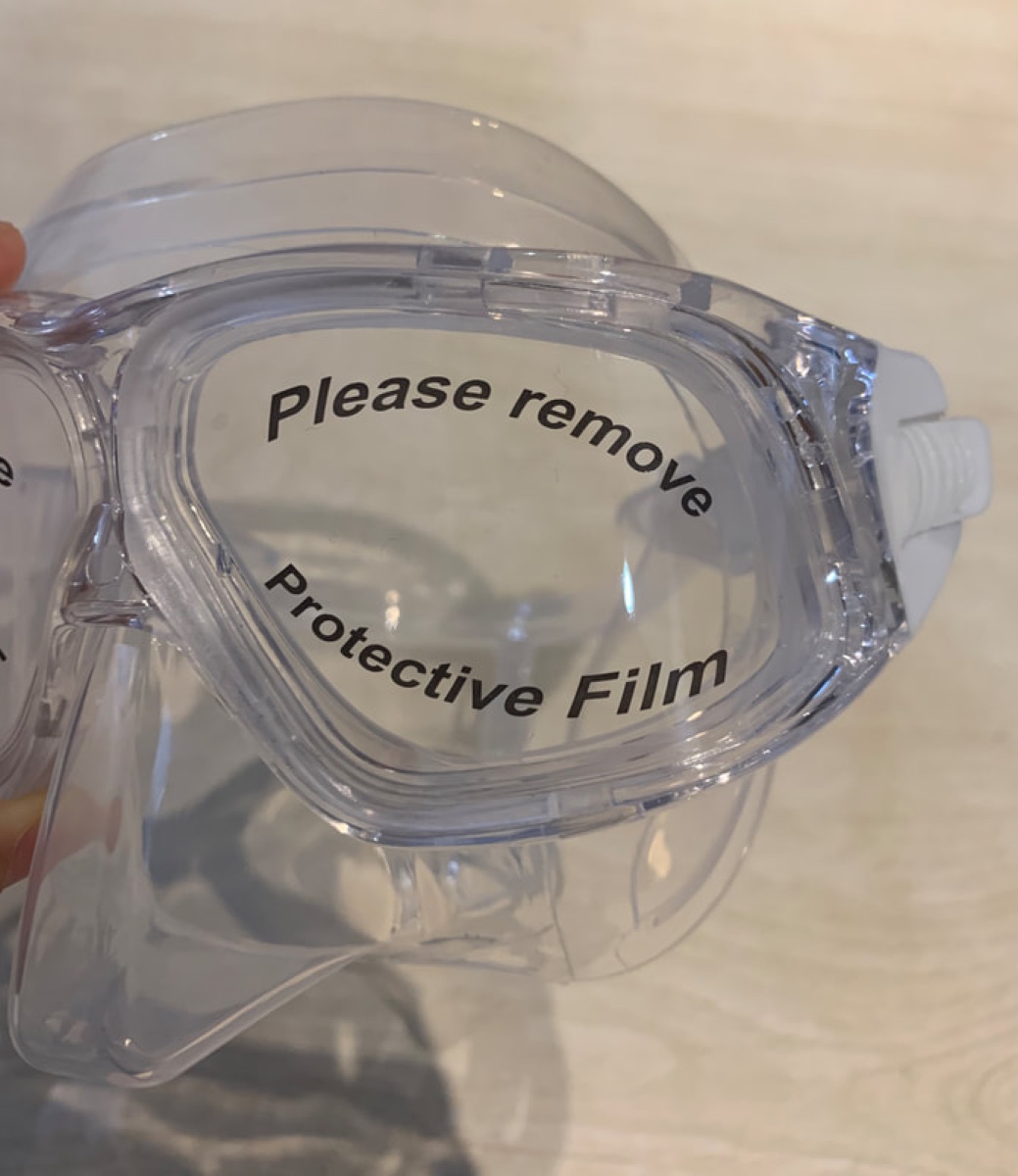
If your mask has a tempered glass lens, the fastest method is to run a lighter flame over the inside of the lens to burn the film off. Ask a scuba instructor about this — they are generally very good at it.
A few conditions have to be stated clearly though:
- Only glass lenses can be burned. A resin or plastic lens is destroyed by flame. So if you bought a curved mask with a resin lens, this method is not available to you
- Keep the flame away from the skirt. Silicone warps and melts
- Do not put it into cold water straight afterwards. A sudden change from very hot to very cold can shatter the glass
If you would rather not use fire, there is a slower but safe alternative: scrub the inside of the lens repeatedly with plain white toothpaste containing silica (not a gel, and nothing with abrasive beads). That works on both glass and resin, but it needs several rounds to get fully clean.
What mask squeeze is, and what it looks like
If the air in the mask does not get replaced, what happens?
As you descend the air compresses, the pressure inside the mask drops below the water pressure outside, and the whole mask becomes a suction cup pulling your face and eyes into it. That is mask squeeze, properly called facial barotrauma.
So what actually happens if you do not add air? It comes in stages:
Stage one: you feel it. A sucking, tightening sensation around your face and eyes, as if the mask is being pulled onto you. That feeling is the warning, and it is your cue to add air. Most people add air at this point and nothing further happens.
Stage two: capillaries start to rupture. The negative pressure pulls the mask inward, that mechanical stress acts on the soft tissue around the eyes and face, and the superficial capillaries give way. You will not necessarily feel this part. Plenty of people only find out when someone points at their eyes back on the boat.
Stage three: the visible injury. It looks like:
- Pressure marks from the mask, far more pronounced than usual
- Facial pain, redness, bruising
- Swelling around the eyes, with red-brown or purple spots (petechiae), especially on the eyelids
- Bloodshot patches in the whites of the eyes — subconjunctival haemorrhage
Mild skin signs generally clear on their own in one to two weeks. Severe cases are less common, but eye pain, proptosis and double vision have all been documented.
Two things worth stressing:
First, this is not a deep-diving problem. The sharpest pressure change is in the first 10 metres — pressure doubles over that stretch alone. Beginners get squeezed in very shallow water.
Second, do not use pain as your guide. The capillary-rupture stage is often painless. What actually protects you is making the exhale a habit, rather than waiting for your body to tell you.
Prevention is simple: exhale a little through your nose into the mask as you descend. The easiest way to remember it in practice — every time you equalise your ears, exhale a small amount through your nose at the same time. Doing them together means you will not forget.
If you do get squeezed, the bloodshot appearance usually clears on its own, but end the dive and let your face recover. Eye pain or any change in vision means seeing a doctor.
Swimming goggles are not for diving down
This deserves its own section, because it genuinely injures people.
Goggles cover only your eyes. They do not cover your nose, which means they cannot be equalised. There is no way to get air into them.
So as you descend, the air inside compresses and there is nothing you can do about it. All of that suction is taken by your eyes. It is one of the classic causes of mask squeeze.
Goggles are fine for swimming. But anything involving going down needs a mask that covers your nose and can be equalised.
(There is a separate thing called fluid goggles, used by deep competitors, which works on an entirely different principle. That is for another day.)
Recap
- The suction test: flip the strap forward, clear your forehead, place it on your face, inhale gently through your nose, let go — if it holds, it fits
- Then shake your head to confirm, and only then fit the strap. The strap holds position; it is not there to clamp the mask down
- The air in the mask does not escape on descent, it is only compressed. But the frame is rigid, so the space has to come from your face
- At 10 m a 100 mL mask needs 50 mL of your face to bulge in — your face cannot, so the deficit becomes force on your face. That is why the mask has to be equalised
- The feeling that the mask draws air from your nose is accurate: your airway is at ambient, the mask is below ambient, and gas flows on its own once the passage is open
- Smaller volume genuinely saves air: at P atmospheres the mask needs an extra (P−1) times its own volume in surface air. At 30 m that is about 5% of your air for a low-volume mask, about 12% for a standard one
- The real obstacle for Asian faces is the nose pocket — most low-volume masks are moulded for European faces, and the pocket can be too deep to reach your nose. That is the mould, not you
- The nose pocket has to allow two things: pinching your nose (to equalise your ears) and exhaling through it (to equalise the mask)
- If you cannot reach, change technique: from "squeeze toward the middle" to "press in toward the face"
- Mask squeeze looks like: heavy pressure marks, bruising, swelling around the eyes, bloodshot eyes. Prevent it by exhaling a little through your nose every time you equalise your ears
- A mask is a consumable: resin lenses (especially curved ones) scratch, and silicone skirts stiffen on the shelf and start letting water in. Any low-volume mask will do; you do not need an expensive one every time
- Unbranded masks are fine, but test them in the bathtub first; take more than one mask to the pool or open water
- If you have long hair: a fabric strap catches hair far less, but do not get a thin one, and it loses elasticity over time. If you keep the silicone strap, wear a hood under it so it stops slipping
- A new mask must be de-filmed: there is a silicone release film inside the lens from the factory, and nothing will stop the fogging until it is gone. Burn it off a glass lens with a lighter (never a resin lens, and keep the flame off the skirt), or scrub repeatedly with white silica toothpaste
- Swimming goggles are not for diving down — they do not cover your nose, so there is no way to equalise them
References
- Low-volume masks let freedivers equalise the mask with far less air, keeping more in the lungs — Tide Trek, Why Low-Volume Masks Aren't Just For Freedivers
- A larger internal airspace requires more displacement at depth and pulls harder on the face — Vanguard Swimming, Why Low Volume Mask for Freediving?
- Low-volume freediving masks hold roughly 100 mL or less (e.g. the Cressi Nano); standard snorkel and scuba masks hold two to three times that — OpenWaterHQ, Best Low Volume Mask for Freedivers and Spearos; Tide Trek (ibid.)
- The depth/air-volume arithmetic here is derived directly from Boyle's law (PV constant), not quoted from a single source
- Mask squeeze is caused by failing to equalise the mask's airspace during descent, creating negative pressure relative to ambient — StatPearls, Diving Mask Squeeze (NCBI Bookshelf)
- Symptoms include facial pain, redness, bruising, periorbital swelling and subconjunctival haemorrhage; severe cases may involve eye pain, proptosis and diplopia — ibid.
- Negative pressure draws the mask inward; mechanical stress ruptures superficial capillaries, producing subconjunctival haemorrhage and periorbital petechiae. Mild skin signs resolve in 1–2 weeks — ibid.
- Symptoms often become apparent only after surfacing (petechiae and swelling on the eyelids) — DAN, Mask Squeeze (Facial Barotrauma)
- Prevention is to exhale gently through the nose into the mask during descent, paired with each ear equalisation — DAN, Mask Squeeze (Facial Barotrauma)
- Goggles that cover only the eyes cannot be equalised and are unsuitable for descending — Go Freediving, What is Mask Squeeze — And Why Does It Happen?
- Masks ship with a silicone protective film on the inside of the lens; fogging cannot be prevented until it is fully removed — PADI, How To Prepare A New Mask For Scuba Diving
- The flame method applies only to tempered glass lenses; flame near the silicone warps or melts it; a sudden hot-to-cold change can shatter the glass. White silica toothpaste works on both glass and polycarbonate but needs several rounds — Scuba Diver Life, To Burn or Not to Burn Your New Mask