
Learn › Terminology
Freediving discipline abbreviations: where do the letters actually come from?
STA, DYN, DNF, CWT, CNF, FIM, VWT, NLT — none of these are arbitrary. Every letter comes from somewhere, and once you see the pattern you do not have to memorise them. Also: why it is "weight" and not "mass", and what actually gets checked at a competition.
Freediving has a lot of discipline abbreviations, and most people simply memorise them.
But none of them are arbitrary. Every letter comes from somewhere. Once you can see where, there is not much left to memorise.
Ten disciplines, and where the letters come from
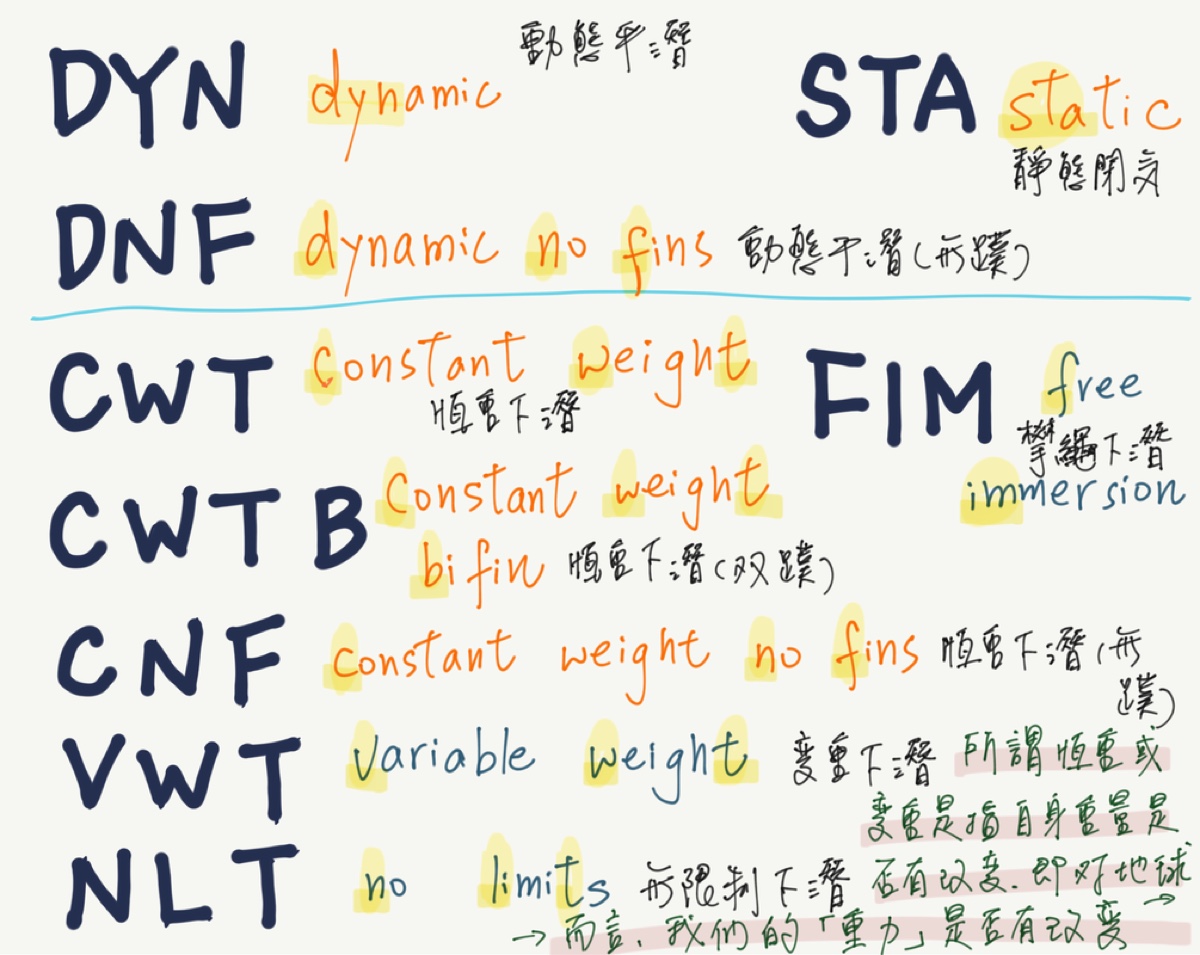
The bold parts are the source of the abbreviation:
| Abbreviation | Full name | What it is | Venue |
|---|---|---|---|
| STA | Static | Breath-hold, stationary | Pool |
| DYN | Dynamic With Fins | Distance with fins or monofin | Pool |
| DYNB | Dynamic With Bifins | Distance with bifins | Pool |
| DNF | Dynamic No Fins | Distance without fins | Pool |
| CWT | Constant Weight With Fins | Depth with fins or monofin | Depth |
| CWTB | Constant Weight With Bifins | Depth with bifins | Depth |
| CNF | Constant weight No Fins | Depth without fins | Depth |
| FIM | Free Immersion | Depth by pulling the rope | Depth |
| VWT | Variable Weight | Depth by weighted sled, ascend under own power | Depth |
| NLT | No Limits | Depth by sled, ascend by any method | Depth |
The pattern:
- Anything starting with D is Dynamic — the only difference is which fins
- Anything starting with C is Constant weight — again, the only difference is which fins
- N and F together mean No Fins
- B means Bifins
So DYN, DYNB and DNF are one family, and CWT, CWTB and CNF are another. Two stems plus three suffixes gets you six of the ten.
Constant and Variable come from mathematics
This is the part I think is most worth explaining.
In mathematics, a constant is a fixed value and a variable is one that changes. These two disciplines are named exactly that way.
Constant weight (CWT) is named in contrast to variable weight (VWT).
Both happen at the Earth's surface, so what is being described is whether the weight acting on you changes:
W = m × g
weight = mass × gravitational acceleration
At the Earth's surface, g is fixed, so a change in weight means a change in mass. And these disciplines involve no other power source — no motors, no external energy — so it reduces to the Earth pulling on a mass m with a force of mg.
- CWT: the weight you carry is unchanged for the whole descent and ascent → a constant
- VWT: you sink on a ballasted sled, leave the sled, and come up under your own power → the weight changed during the dive → a variable
This is also why the English word is weight, not mass: what matters here is the gravitational force, not simply how much matter there is.
"Constant" is something that actually gets checked
Constant weight is not an abstract label. The competition rules give it a concrete enforcement mechanism.
AIDA's depth discipline rules say it plainly: the jury notes the weights the athlete takes into the water, and checks for any change in weight when they come out. If it changed, the athlete is disqualified.
So the "constant" in constant weight is a thing that gets weighed.
The bifins categories are not just about the fins
DYNB and CWTB became separate disciplines later than the rest — dynamic bifins in 2018, constant weight bifins in 2019.
But what separates them from DYN and CWT is not only which fins you wear. The rules add a specific condition:
In DYNB and CWTB the athlete is prohibited from using a dolphin kick for propulsion. Using one while wearing bifins results in disqualification.
In other words, the bifins categories are for bifin technique, not for wearing bifins while imitating a monofin. That is why they earn their own category — they measure a different skill.
What separates VWT from NLT? The ascent
These two get confused often, because the descent is the same — both sink on a ballasted sled.
The difference is how you come back:
| Descent | Ascent | |
|---|---|---|
| VWT Variable Weight | Ballasted sled | Own muscle strength only. Fins and pulling the rope are allowed, but motorised aids and gas-filled balloons are forbidden |
| NLT No Limits | Ballasted sled | Any method the athlete chooses — balloon, counter-balance system, ballast |
So the "no limits" in No Limits refers to the ascent having no restrictions.
That is also why NLT holds the deepest records: nobody has to swim back up. VWT makes the descent effortless, but the ascent is still yours to do, so it cannot reach the same depths.
Back to the naming point from earlier: VWT is called "variable" because the sled is left behind and the weight changed during the dive. NLT also leaves the sled, but its name is not about the weight at all — it is about the ascent being unrestricted.
VWT and NLT no longer sit where older sources put them
A lot of older material has not been updated on this, so it is worth stating clearly.
VWT (variable weight) — AIDA now treats it as a record-attempt discipline only (national and world records). AIDA does not sanction any event that includes VWT as part of a competition.
NLT (no limits) — AIDA no longer sanctions it at all. The history of records is maintained, but that is all.
So if you find a source listing all ten as "competition disciplines", it is out of date. Eight actually appear in AIDA competitions: four in the pool (STA, DYN, DYNB, DNF) and four at depth (CWT, CWTB, CNF, FIM).
Recap
- Every letter comes from somewhere: D is Dynamic, C is Constant weight, NF is No Fins, B is Bifins
- Two stems plus three suffixes accounts for six of the ten
- Constant and variable are the mathematical terms: CWT keeps the same weight throughout; VWT sinks on a sled, drops it, and ascends — the weight changed
- It is weight, not mass, because what matters is gravitational force (W = m × g), not the quantity of matter
- "Constant" is enforced by weighing: the jury records what you carry in and checks it when you come out; any change is a disqualification
- The bifins categories forbid the dolphin kick, on penalty of disqualification. DYNB and CWTB measure a different technique, not just different equipment
- VWT and NLT differ in the ascent: both descend on a ballasted sled, but VWT must be ascended under your own muscle power (no motors, no balloons), while NLT allows any method. That is what "no limits" refers to
- VWT is record-attempts only and cannot be part of a competition; NLT is no longer sanctioned at all, with only its record history maintained
- The disciplines you will actually see in competition are eight: STA, DYN, DYNB, DNF in the pool; CWT, CWTB, CNF, FIM at depth
References
- The ten disciplines AIDA recognises and their definitions — AIDA Competition Rules and Regulations, Version 17.5, March 2024, §3.1
- VWT is a record-attempt discipline only; AIDA does not sanction events including it as part of a competition — ibid., §3.1.1
- NLT is no longer sanctioned by AIDA; the record history is maintained — ibid., §3.1.2
- Pool disciplines are STA-DYN-DYNB-DNF; depth disciplines are CWT-CWTB-CNF-FIM — ibid., §3.3.10.6
- In depth disciplines the jury notes the athlete's weights and checks for changes on exit; a variation means disqualification — ibid., §8.1.3
- The dolphin kick is prohibited in DYNB and CWTB, with disqualification as the penalty — ibid., §7.1.4 and §8.1.4